Showing posts with label Building Material. Show all posts

Wednesday, July 1, 2020

Different Testing Of Bricks

Different Testing Of Bricks

Bricks are widely used construction material in construction industry. They are prepared by Clay which is the main constituent in Brick manufacturing. The Clay which is used in preparation of brick is Kaolinite (2Sio2Al2O3.2H2o). The clay is used because of the properties it shows as it the purest clay with least quartz, mica, magnesite, calcite, felspar.

The clay have bulk Specific Gravity in range of 1.6- 2.5.

These bricks are widely in use because of economically they are cheap and are easy to do work with.

To get the quality of the work, the quality of brick should be maintained. For which we conduct different tests on the bricks.

 For conducting the test, Bricks are picked on a random manner in a lot of

No of Bricks picked randomly (no’s)

Bricks taken from stack of (no’s)

1) 20

2000-10000 Brick stack

2) 32

10000 - 35000 Brick stack

3) 50

35000-50000 brick stack

 Note - In the case of bricks less than 2000 no’s , The number of bricks taken for sample for the test should be taken between the mutual understanding of the contractor and the purchaser.

Different Testing Of Bricks

1) Water Absorption Test

(a) 5 Hours boiling Water test

  •  In this test firstly we take random 10 specimen (brick) and Dry each of them inside the Ventilated  Drying Oven which maintains the temperature in the range of 110–1150C.The time usually takes in drying process is near about 48hrs.
  • These bricks are cooled down and later the weight is taken.
  • After the weight is taken, the specimens are immersed inside the tank filled with water, with a proper arrangement of maintaining a gap of 10 mm between the bricks so as there will be proper water circulation between the gaps of the bricks.
  • The water is than boiled to for continuous 5 hrs and later the bricks are taken out and are cooled in the natural manner at room temperature, which usually takes a time of 16-19 hrs in cooling.
  • After cooling, Specimen is wiped with a clean cloth and within 2 minutes, the bricks are weighted and the water absorption is find out.
Water Absorption Test

(b) 24 Hours Immersed Water test

(i) The test is conducted to find out the strength of the brick,or the class of brick based on its absorption capacity. The Classification of bricks you can find here.

(ii) Bricks are immersed inside the water for 24 hours in this test.

(iii) The more the absorption will take in the brick. The faster the brick will loose its strength.

(iv) This test is conducted by keeping the temperature of water of +/- 270C

Brick Class

Water Absorption

1) First Class Brick

12% to 15%

2) Second Class Brick

16% to 20%

3) Third Class Brick

20% to 25%


2) Compressive Strength Test 

Compression Strength test is a method in which the compressive strength of the brick is found out.14 N/mm2 constant load is applied to the brick until failure in the brick is observed.

(i) The process is carried out by firstly immersing the brick in water for about 24hrs. After that the brick is taken out and the frogs on the bricks are filled with cement mortar in a ratio of 1 part of cement and 1.5 part of sand.The bricks are than kept for 24 hrs in area where the mortar can get water for the setting purpose and later they are immersed in water for another 6 days.

(ii) Now already the mortar achieve its strength in the time period of 7 days, the bricks are taken out and cleaned with dry cloth and later ready for the Compressive strength test.

(iii) The compressive test is found out with the formula

Compressive Strength Test

3) Warpage Test


Warpage mean checking out or observing the specimen on the basis of the twists or defects on the surface of the specimen.

For a brick it can be said as, it is the greatest distance in the brick from one point to the other point in as straight line with no single defect or twist.

The warpage of the speciment or the bricks are measured in a mesuring tool as a ruler shown in the image below.

The Warpage is measured in two types based on the physical characteristic of the brick which are

Concave & Convex Warpage

(i) Concave Warpage.

(ii) Convex Warpage.

We will now take about how they work to find out the defect in the brick.

 Concave Warpage

In the concave warpage method, the brick is rested on the surface of warpage, as shown in the photo above. After that the distance is measured from one corner of the brick to the point where the concave deflection of the brick starts.

Convex Warpage

In convex warpage method,the brick is placed in such a manner that the brick surface is kept on the plane surface and the convex defect of the brick at plane surface.

The Flat distance of the bricks in both the method determine the warpage of the brick.

4) Efflorescence test

The test is basically conducted to check out the alkalies present inside the bricks


Alkalis

They are normally present of about less than 10% of of brick composition.

The excess of them causes efflorescence in the brick which results in making the brick clay unstable.


The process of this test is,

We take a dish of 150mm, and fill the dish with water upto 25mm. Now the brick is inside the dish and made the brick absorb all the water on the dish until the dish gets dry or the water gets evaporate.

Now again the same process is executed of filling the water till 25mm dept upto the absorption limit of brick and after this second time they are tested.

We classify the brick after test on the basis of

Classification of Bricks

% of Efflorescence

Nil

Visual deposits are not observed

Slight

< 10%

Moderate

10-50%

Heavy

 >50%

Serious

Heavy & powdered


5) Soundness Test

 The test is widely used in field in which two bricks are taken randomly from the stack and are made to hit them with each other. If we observe the sound coming out of the bricks are kind of metallic sound, than they are considered to be good quality bricks.

Related Topics

Brick Masonary

Classification Of Bricks


Monday, June 22, 2020

Manufacture Process Of Bricks

 Manufacturing of Bricks 

Manufacture Process Of Bricks


Brick is widely used material in construction industry whose major raw material is clay. To manufacture the brick, various activities are been carried out from preparation of the Brick earth to the process of burning of bricks in kilns. Today in this topic we are going to see how the Manufacturing of Bricks is carried out.

1) Preparation of Brick Earth

The preparation of brick earth is carried out in four process
  • Unsoiling
  • Digging
  • Cleaning
  • Weathering
  • Blending
  • Tempering

Unsoiling

The soil top is considerably full of impurities such as large lumps, stones, shales etc making the soil unfit for the use, to overcome the issue the top soil of about 20cm  or 200mm  is dug out with the help of powerful equipment such as JCB's , poclain etc and thrown away.

Digging

After the impure soil is removed, the clay underneath the impure soil is dug out and is spread over the leveled ground or the plant storage area in the form of heaps for maximum 1.5m of height. 

Cleaning

The clay is cleaned is this process by removing the lumps, stones, pebbles, shales etc because they will lead in generating voids inside the bricks which will result is degrading the compressive strength or the crushing strength of the brick. the cleaning is done by washing off the materials if are in excess and the lumps are crushed with help of crushing tools or rollers.

Weathering

In this process the cleaned clay is left in the ground under the atmosphere for certain weeks to month so as the clay gets homogeneous and soft in nature

Blending

Water is added of about 12-15% of the weight of clay to make the clay loose

Tempering

The clay is kneaded by feet of people or with the help of kettle, which been carried out within 36 hrs of the blending process just to make the mixing homogeneous and uniform.For Large scale the tempering is done with the help of pug mills which is known as ' pugging', which can yield about 1500 bricks a time. 

2) Moulding

Moulding is a technique in which, the cohesive clay which we have prepatred by the process of tempering is put inside the rectangular moulds of bricks make of steel or wood. The moulding is carried out in two ways
  • Hand Moulding
  • Machine Moulding

(i) Hand Moulding

Ground Moulding

Mostly Soft-mud is preferred in this technique.The ground moulding is done where large land is available. The land is first leveled as if the surface is uneven, the bricks prepared will not be straight and will tend to show uneven surface of brick, than the ground is covered with sand so to overcome the problem of absorption of water to the ground and impurities getting stuck to the clay particles from the soil.
Once the land is prepared, The mould inner surface are applied with certain substance such as water or sand etc so as the wet clay which we are about to fill in moulds dont get stick to the surface.
Once we  done with sprinkling of sand or water to the inner surface, the clay is filled inside the moulds and is pressed manually with a force and the extra clay coming out from the top surface is removed with a metal blade or wire for better finish. The mould is than removed and washed with water and the process is repeated again.

They have certain disadvantages as
  • They dont have frog (provided of shear whose dimension is 100mm x 40mm x 10mm or 20mm) .
  • Bottom surface of these bricks are rough in nature.

Table Moulding

Same procedure as ground moulding is followed in this but the only difference is, Table moulded bricks are moulded on Table mould whose dimension is 2m x 1m whereas ground moulded bricks are prepared on ground surface. Table moulding is adopted when the frogs are required on the brick surface. In this technique the mould is not removed right after filling of clay due to which economically the cost of this type increases as compared to ground moulding technique.
After moulding is done, the bricks are carried to dry area or the dry site of the bricks.

(ii) Machine Moulding

Mostly Stiff mud is preffered in this technique.When we have to do brick production in large scale, than the machine moulding technique is implied. There are many advantages of machine moulding such as
  • Less time required.
  • More Economical.
  • Less Space Required.
  • Large Production.
  • Less Labour required.
  • Hard, Durable and Sound bricks are manufactured.
Machine moulding is carried out in two ways 
  1. Plastic Method
  2. Dry Press Method

Plastic Method

In this technique, the stiff clay is is forced to move out from a rectangular opening which is provided in machine. Once the Brick cake is moved out in a large rectangular form, the bricks are been cut in the form of brick shape and length required with help for cutting blades or sharp wires by machine only, After that the bricks are moved to dry.

Dry-Press Method

In this technique, the stiff clay is help in the mechanical operated press mould and is pressed at a high pressure which result in taking up the shape of bricks with frog to it. After that they are moved to dry.

3) Drying

  • The moisture of the moulded bricks are removed maintaining shrinkage of the bricks by drying the bricks under sun which leads in saving fuel and time in burning them.
  • Within a period of 3-4 days the moisture content is brought down to 3%.
  • As we arrange bricks on stack which normally consist for 10 stairs, there are space kept between them for the movement of air, and within stacks a width of 1m is left for the movement of people and ventilation.

4) Burning

The burning process is carried out in 3 ways,
  1. Dehydration Period - In dehydration period, the bricks are burnt in temperature ranging between 400-600C. The process is done to ensure complete vaporization of the moisture content inside bricks.
  2. Oxidation Process - In the oxidation process, the bricks are burnt in the temperature ranging between 650-900C resulting in oxidation of ferrous iron to ferric forms, which improves impermeability and ductility of the bricks resulting in giving strength to them.
  3. Vitrification Process - Bricks are burnt ranging between 900-1200 C which results in making them cherry red, making brick strong and sound.
The Burning can further be done in 
  • Clamps - They yield 60% of First Class Bricks
  • Kilns -  They yield about 90% of First Class Bricks.
Brick Kiln
Brick Kiln

Related Topics


Saturday, June 6, 2020

Classification of bricks / Types of bricks

Classification of bricks


Bricks are the structural units used as building materials which are being manufactured with the help of clay.

Clay is considered to be the most important raw material for manufacturing of bricks. The purest clay consists of Kaloinite with small quantity of minerals such as quartz, mica, felsar, calcite and magnesite.
The bulk specific gravity of clay bricks use to range from 1.6-2.5 .

Bricks are widely used because of the ease of clay availability, its low cost and the portability due to its shape and size.
Now we will see the classifications and the types of bricks

Classification of bricks / Types of bricks

Wednesday, June 3, 2020

Brick Kiln

Brick Kiln

Brick Kiln

Introduction of Brick Kiln


Brick Kiln is an ancient technology, who's traditional method (Firing Technique) is still being practiced in countries like India, Pakistan, Bangladesh etc. The kiln technique has been improvised in developing countries years after years. 
The kiln technique is determined in two processes under which the brick are been prepared such as 
  • Intermittent  (Traditional method/Periodic kind of kilns)
Sealing inside kiln - Temperature Increased as per schedule - Kiln and bricks are cooled - Bricks not removed until kiln cools down.
  • Continuous (Mostly preferred in developed countries)
This consist of two different processes which we will see later in the article in which, bricks or fire is been kept stationary and other material is moved. ex- Tunnel kiln, Zig-Zag Kiln, Hoffman etc.

After China, India is the second largest manufacturer of bricks, producing over 10 percent of the global production.

Classification of Brick Kilns


Classification of Brick Kilns


Brick are been prepared in two ways Intermittent  (Traditional method/periodic kind of kilns) and Continuous (Mostly preferred in developed countries)


Firstly we will learn about the traditional method 

Intermittent (Traditional method/Periodic kind of kilns)

They are known as periodic kilns because only one process can be carried out at a time. In this method the bricks the fired in batches inside the kiln. The kiln is been sealed from outside, than the kiln is been heated up as per the schedule. Once the firing of cake is done, the kiln and the bricks are left to cool down. The bricks are been removed once the kiln is cool down properly. For the next cycle the Kiln is properly cleaned.

Now, the intermittent Kilns are further classified into

1)Kilns without chimneys

They are the oldest and most traditional and still been practiced in many countries. This kiln is highly polluting, inefficient fuel use and labour intensive. Clamp firing is of many sizes depending on number of bricks to be fired at once. They are kept side by side to coal or fuel material for burning and space is kept between them for passing of air. Clamp firing has two variants which are
  • Scove Kilns - Wall of the camps are plastered from outside for more efficiency
  • Scotch Kilns- When clamp is surrounded by four walls.

2) Kilns with chimneys

  • Up-draft kilns- In the up-draught kilns the flame is introduced from the bottom and is been exhausted out from the top. they consists of 3 components Fire box (where flame enters), Damper (which controls exhaust at top), Stack area (where bricks are placed).

Up-draft kiln
Up-draft kiln

  • Downdraft KilnsThey are designed in such a manner that the heat and air can circulate through the kiln

Downdraft Kilns
Downdraft Kilns


  • Climbing Fire Kiln- These kilns are long chambers and often close to updraught air flow, they are built on a slope which itself acts as a natural chimney, enhancing the kiln's draw.

Continuous Kilns

The continuous Kilns is been carried out in two process such as moving fire Kiln in which Bricks remain stationary and the fire moves through the kiln with the assistance or help of a chimney or suction and the other is, moving ware kiln in which bricks are moved through a stationary fire zone.

Moving fire Kiln

  • Hoffman Kiln - They are designed with large, permanent masonry arches and expensive tall chimney approx. 30 metres tall. Two parallel tunnels are build side by side consist of a curve tunnel at either side. Chimneys are constructed outside and can be connected to more than 1 kiln.
For effective working they have chambers such as
Minimum - 16 chambers.
Efficient- 22 chambers.

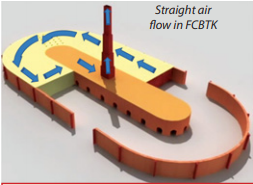
  • Fixed Chimney Bull’s Trench Kiln (FCBTK)- The technology is most widely used in South Asian countries such as (India, Bangladesh, Pakistan and Nepal) , In this the fire is always burning and the circulation of air is always to the direction of the air flow connected to chimney which is considered as straight path. Inside all the process can take place simultaneously such as heating, cooling etc. FCBTK has a tall, expensive 30 meter brick chimney and is highly polluting. they are operated in dry seasons mostly and been operated continuously since fire is always burning inside it.

Fixed Chimney Bull’s Trench Kiln (FCBTK)

  • Zig-Zag kilns-  They are very similar to Fixed Chimney Bull’s Trench Kiln, the difference between both of them is the air flow path which happens in zig-zag manner in this kiln. In this the fire moves in the closed rectangular room and the bricks are arranged in such a manner that fir moves in zig-zag way. The power coal is fed in small quantities in zig-zag kiln and the fuel feeding zone is six times longer than that of FCBTK which results in improved combustion and heat transfer rate and uniform temperature across the kiln cross section.

Zig-Zag kiln
Zig-Zag kiln

Moving ware Kiln

  • Tunnel Kiln- This is a highly mechanized and automated process. These kilns are expensive to construct and required high skilled workers.These kilns are very long and only the central part is heated, the bricks are been transported from the entrance and as the bricks reaches the central part, the central area is more heated observed compare to entrance.


Friday, May 29, 2020

What is a Rebar? Types and Grades of Steel Reinforcement


Rebars

What is a Rebar?

Rebars are the steel reinforcement bars which are used in construction due to its resistance to the Tensile strength. 

In RCC , concrete tends to have a good resistance to Compression strength but when it come to tensile strength, concrete fails. To overcome this issue steel reinforcements are provided in concrete which improves the tensile strength of the construction.

Steel is used because the elongation of steel due to high temperature which can be said as thermal expansion coefficient is nearly equal to the concrete.

Carbon steel is most commonly used rebar, which consists of hot-rolled round bars with deformation patterns.

In working drawing at site, Rebars details are give as 

Example. 4no's, 16ΓΈ 250 cc
Which dentoes 4 number of rebars having centre to centre spacing of 16 diameter rebar.


Grades of Rebar in Different Codes & Sizes

India

Grades and sizes of bars used in Indian Standard (IS: 1786)
  • Grades- Fe 415, Fe 500, Fe 500D, Grade Fe 550
             whereFe - Ferrous material i.e. iron
                         415,500 etc - Yield Strength in N/mm2( Mpa)
                         D - Extra elongation/ Ductility 

Different sizes of Rebars used in India-
  • 6mm, 8mm, 10mm, 12mm, 16mm, 20mm, 25mm, 32mm, 36mm 
  • Bars like 40mm, 50mm , 60mm are directly ordered on factories.
America

Grades and sizes of bars used in American Standard (ASTM A 615)
  • Grade 75 (520), Grade 80 (550) 
Different sizes of Rebars used in America
  • 6mm, 10mm, 13mm, 16mm, 19mm, 2mm, 25mm, 29mm, 32mm, 36mm, 43mm, 57mm
Europe

Grades and sizes of bars used in Euro Standard(DIN 488)
  • BST 500 S, BST 500 M
Different sizes of Rebars used in Europe
  • 6mm, 8mm, 10mm, 12mm, 14mm, 16mm 20mm 25mm, 28mm, 32mm, 40mm, 50mm.
Australia

Grades and sizes of bars used in Australian Standards AS/NZS4671-2001
  • 250N, 300E, 500L, 500N, 500E (Mpa)
Different sizes of Rebars used in Australia
  • 12mm, 16mm, 20mm, 24mm, 28mm, 32mm, 36mm.
British

Grades and sizes of bars used in British Standard BS4449: 1997
  • GR 460 A, GR 460 B 
Now, We will see different types of Steel reinforcements,

The steel reinforcement used in concrete construction is of 4 types

Hot Rolled Deformed Steel Bars


  • Hot rolled deformed bars are most commonly used steel reinforcement for R.C.C structures.
  • They have ribs on the surface
  • They are of different types such as :- TMT (Thermo mechanically treated), HYSD (High yield strength deformed bars)
Cold Worked Steel Bars


  • They are obtained by putting the hot rolled deformed steel bars into cold water.
  • This lets the bars twist.
  • The process is done at room temperature and since the bar dont show plastic yield, it is considered as less ductile compared to hot rolled deformed steel bars.
Mild Steel Plain Bars

  • These bars show plain surface.
  • Bars dont have ribs on the surface.
  • They are used in small projects , not on heavy structures.
Pre-stressing Steel Bars


  • Commonly known as strands or tendons (made of 2-7 wires).
  • Multiple tendons are used and pre-stressing is carried out.


We will discuss more about Steel Reinforcements in concrete structures in next article.

Thursday, May 28, 2020

Bonds In Bricks - Brick Masonry

Bonds In Bricks - Brick Masonry

Bonds of the bricks can be defined as the arrangement of the bricks so as the vertical joints may not come above each other, which will result in decreasing the strength of the wall.

These Bonds helps to reduces the stresses coming to the brickwork , making it uniformly distributed to the surroundings.


To break the continuity of vertical joints closers or bat are provided in alternative courses.

Lets take and example - Put few books one above the other, next to it place same number of books so as the joints will come at the same line. Once you apply the force , it will be easier to remove them.

You will get a better idea by looking to the image.


Now same we arrange the books similar to the Bonds in which the vertical joints may not come above each other.

    `        `

From above we can see, if we apply force there will not be effect of shear as much as in example 1
That is the reasons we apply bonds in Brick masonry.

Types of Bond

  • Stretcher Bond.
  • Header Bond.
  • English Bond.
  • Flemish Bond.

Stretcher Bond. (running bond)


Long narrow face of the brick is called as stretcher. The bond is created when bricks are laid with only their stretchers showing, overlapping midway with the courses of bricks below and above.
This type of Bond is only used in 4 inches walls, which can be termed as half brick thickness walls. 

This bond is not as effective if we compare it with full length brick wall 

The walls in strecher bonds are not stable enough for long span and height. Toovercome the problem supportings are been provided such as columns at regulat intervals. Due to which we usually provide columns at every 4m and coping(a rcc of 75mm-100mm) at 1.2-1.5m height.

These are commonly used as partition, reinforcement or steel outer face structures or boundary walls
.

Header Bond (Spanish bond) or (heading bond)


Headers are shorter square face of the brick which measures 9cm x 9cm . These bonds are very common bond for bearing walls. They consists of header bricks, which are set in rows with an offset of ¾ of a brick which is determined as a quoin brick in alternating courses.

 In header bonds, all the bricks at each course are laid as headers of the bricks facing wall.

These bonds are used in full brick thickness wall measuring 230mm.

In header bonds, all the overlaps are arranged in such a manner that the overlap should come as equal to half width of the brick. To accomplish this, three quarter brick bats are used in alternate courses which are named as quoins.


English Bond


English bond in brick masonry are the arrangements in which one course is made of strechers and above it the other course in made of headers of the bricks, So we can say that , they are alternative arrangements of headers and stretcher bonds.

Quoin closer are provided at the beginning and the end of headers to break the continuity of vertical joints.
Quoin close is a brick which are cut in lengthwise in 2 half's after which they are used as corners in brick walls.

Advantages of English bond

  • The strongest bond
  • This bond maximizes the strength of wall
  • Pattern on the face of the wall shows distinctive courses of headers & stretchers.

Flemish Bond (Dutch bond)


They are laid alternate headers and stretchers in a single course. The second course of brick is laid such that header lies in the middle of the stretcher in the course below. The thickness of wall use to be of 1 full brick i.e 230mm.

The alternative course in this bond are started with a header from corner of the wall.
  • Alternate headers & stretchers shows decorative pattern at the face of wall.
  • To break the continuity of vertical joints queen closers are provided after every queen headers at alternative courses.
  • Brick bats are used when required.


Wednesday, May 27, 2020

Brick Masonry

Brick Masonry


Brick Masonry
Brick Masonry

Bricks masonry is a form of construction performed by bricks with motar (mix of cement and sand), which are laid and arranged in different manners known as bonds such as Stretcher Bond, Header bond, English Bond, Flemish Bond.

These bonds are highly durable in construction of brick masonry.

Durable brick masonry walls are laid as one on top of another and the plumb is been checked to check the verticality of the wall. The Laying process defined as bonds, are different arrangements on placement of bricks resulting in durability strength and thickness of wall.

There are various types of brick Masonry work performed with fillers such as
  • Bricks laid with mud 
  • Bricks laid with motar

1) Brickwork with mud

  • Soil Should contain clay of 10%- 20% to make is ideal for mud motar
  • The Stress can be taken in dry condition - 1.5 to 4.0 N/mm2
  • Stress it can take in wet condition - 1.3 to 3.3 N/mm2
Note - Moisture reduced compressive strength drastically

Application
  • Construction should be done for only 1 floor and it should not be in seismic zone.
The advantage of this construction is, It is a cheap process and cement, aggregates are not required.

2) Brickwork with cement motar

    `
Cement motar is essential material to make bonding between bricks, The proportion of the bricks are considered on the area where we are going to use and so as the ratio is determined.
Normally the ratio varies between 1:4 to 1:7 in which one part is of cement and the other part is of sand.
The proper use of ratio increase effectiveness of the structure we are going to construct.

Following the there ration proportions usually considered.
  • 1:4 mix - one part of cement and four parts of sand.
This proportion mortar is strong and is used for the construction of multi-storey buildings, building pillars, heavy or load effective walls, boundary wall and structures requiring high strength.

  • 1:6 mix - one part of cement and six parts of sand
They are considered of medium quality and strength. This type of brick mortar is used for construction sites such as: two or three storey building, zones of heavy rainfall, and foundation of heavy/multi-storey building.
  •  1:7 mix - one part of cement and seven parts of sand
Considered as average or normal strength. They are normally used in temporary structures, light walls and single storey construction etc.

Next article we will  learn about different types of Bonds in Brick masonry